Write a comment

Byron's  Broad Street Boyhood

Broad St

                                Broad St2

 No trace of Byron’s boyhood home,

Yet these surrounds he would have known;

Here in Broad Street Aberdeen, 

Because his father libertine –


Had made his heiress mother’s cash

Disappear in a flash!

But as her kin for her retained

A portion, they the journey made


To Aberdeen, as a retreat,

First in Queen’s then in Broad Street,

Living there in straitened times,

Despite her noble Gordon line.


And then his Dad to see her came –

But really just to money claim;

Their quarrels leaving him bereft,

And then his Dad forever left.


The Greyfriars church he would have seen,

In Back Wynd’s passageway have been;

And here he teased his Mum and guests

By throwing out a pillow dressed


In his own clothes from window high

While uttering a piercing cry!

What a shock they must have had!

What relief to see the lad!


‘Dinna speak of it!’ he’d cried

With little whip he then let fly

At tactless nurse who had exclaimed:

‘So sad this pretty boy is lame’.


And then a mile across the town

He found his way, with schoolboy frown,

To the school where he began

That learning which the classics spanned.


He’d read of the exotic East,

On tales Arabian he’d feast;

The Old Testament preferred to New,

But poems all he would eschew.


A helper young by name May Gray

Would ‘tricks upon his person’ play,

And yet a pious girl was she,

A first taste of hypocrisy.


In fact in later life he’d say

This early knowledge spoiled his way,

With those pleasures known too young

His chances of true love undone.


Then one day when he was ten

His childhood would mutate again:

To headmaster’s study he was called

And told ‘Son, now you are a Lord!’


And given cake and claret fine –

His status by that gift defined;

Though he would find the tears sprang

At assembly, when his title rang


Round the room, all turned to see

The new Lord Byron – there revealed!

And so to new life he was called

Beyond that academic hall.


But took with him the memories

Of Scotland’s beauty, wild, serene;

Recalled from Pisa's study room,

Where his remembrances would bloom


In that palazzo there immersed,

Recalling Scotland’s soul in verse.

A late recall before he’d part,

The call of  Greece a burning spark,


That would grow into a flame,

That burned all his old life away:

From women, poet’s fame enticed

For Missolonghi’s sacrifice.


O ye in Broad Street Aberdeen,

Think of him who here has been!


'Half a Scot by birth'

(Byron verses remembering Scotland in song)


The complete rundown!

Byron’s Poems about Scotland
edited by Peter Cochran


Write a comment


BYRON AND ISLAM


Lord Byron still rightly commands continuing fascination as the 'poster boy of the Romantics', the prototype rock star with that complex and colourful love life, the poet whose 'Don Juan' was cited by Bob Dylan as an influence. But there's another aspect on Byron - his engagement with Islam - that is currently almost completely unnoticed, but certainly worth discussion.

For Byron, throughout his life - from his boyhood reading to his deathbed when he was declared 'an enemy of the Porte' by the Sultan in Istanbul - had possibly the closest relationship with Islam that any classic British poet has achieved. The connection certainly ran deep, and at a time when relations between the West and Islam have become one of the hottest topics around, this aspect of Byron's life and thought undoubtedly provides perspectives, thought-pieces, maybe even directions for us today.

Perhaps a good place to start is with Byron, in 1810, in Athens under Ottoman rule, taking his evening ride down by the sea. Talking to Shelley's cousin Tom Medwin in Pisa he told how he had 'observed a crowd of people moving down to the shore, and the arms of the soldiers glittering among them. ..I thought I could now and then distinguish a faint and stifled shriek. I dispatched one of my followers to enquire the cause of the procession. What was my horror to learn that they were carrying an unfortunate girl, sewn up in a sack to be thrown into the sea ! I did not hesitate as what was to be done. I knew I could depend on my faithful Albanians, and rode up to the officer commanding the party, threatening, in the case of refusal to give up his prisoner, that I would adopt means to compel him. He did not like the business he was on - or perhaps the determined look of my bodyguard - and consented to accompany me back to the city with the girl, whom I soon discovered to be my Turkish favourite. Suffice it to say, that my interference with the chief magistrate, backed by a heavy bribe, saved her; but only on condition that she immediately quit Athens'.

The girl had been sentenced to death by the Turkish ruler of Athens for acting in a sexually free manner - possibly with Byron himself. The story supports the comment that 'Lord Byron could never be the idle spectator of any calamity', but also reveals his courageous opposition to the inhumanity that can arise from the application of Islamic law.

Let's immediately contrast this with another Byronic encounter with Islam, this time from the realms of his imagination, in the final cantos of Don Juan, written about eighteen months before his death. Byron's appreciation of the vitality of peoples and nations has been pointed to as a fundamental quality of his life and work; this emerges in his treatment of Russian/Turkish warfare in Canto XIII of the poem. The final stanza ends with the victory of Russian forces, and the poem's hero left alone with an orphaned Muslim girl. What Byron wrote displays a sorrow at the eradication of Islamic culture, and an empathy with the sole survivor:

'The Moslem orphan went with her protector,

For she was homeless, houseless, helpless.

All Her friends, like the sad family of Hector,

Had perished in the field or by the wall.

Her very place of birth was but a spectre

Of what it had been; there the muezzin's call

To prayer was heard no more.And Juan wept

And made a vow to shield her, which he kept'.

The empathy in those lines reveals the depth of his humane engagement with Islam - why else would Juan weep? It demonstrates his refusal to demonise other groups, the impulse that is the primary force behind ethnic cleansing.

In his childhood, as mentioned above, Byron's imaginative life was kindled by boyhood reading about the East, including a history of the Ottoman Empire. He recalled later: 'it was the first book that gave me pleasure when a child; and I believe it had much influence on my subsequent wishes to visit the Levant, and gave, perhaps, the oriental colouring which is observed in my poetry'. Certainly an engagement with Islamic thought can be seen in his first collection of poetry Hours of Idleness. His poem 'To Eliza' records a frank disagreement with aspects of Islamic theology, and is worth considering in full:

Eliza, what fools are the Mussulman sect,

Who to women deny the soul's future existence!

Could they see thee Eliza, they'd own their defect,

And this doctrine would meet with a general resistance.

Had their prophet possess's half an atom of sense

He ne'er would have woman from paradise driven;

Instead of his houris, a flimsy pretence,

With woman alone he had peopled his heaven.

Yet still, to increase your calamities more,

Not content of depriving your bodies of spirit,

He allots one poor husband to share among four!

- With souls you'd dispense; yet this last, who could bear it?

His religion to please neither party is made;

On husbands most hard, to the wives most uncivil;

Still I can't contradict, what so oft has been said,

'Though women are angels, yet wedlock's the devil'.

In a society trying to treat all cultures with respect, Byron's post-Enlightenment boldness is startling - from 'what fools are the Mussulman sect' to 'Had their prophet possess'd half an atom of sense....' I can hear the charge of 'Islamophobia' already, but I'm not so sure. Personally I wouldn't attack people's ideas by calling them fools, but this brutality of the mind (or frankness) is a part of western life, and certainly an inheritance of the Enlightenment; it is a tradition that people from Islamic backgrounds cannot expect their ideas to be exempt from.

Salman Rushdie put it well when he wrote: 'to attack people's ideologies or belief systems is not to attack the people themselves. This is surely one of the foundation beliefs of a free society. Citizens have the right to complain about discrimination against themselves, but not about dissent, even strongly worded impolite dissent, from their thoughts. There cannot be fences erected around ideas, philosophies, attitudes, or beliefs'. In the end 'To Eliza' makes genuine and legitimate criticism of an aspect of Islamic thought (and how delightful is the description of the houris who motivate suicide bombers as a 'flimsy pretence'): 'Islamophobia' consists of ethnic cleansing, racist attacks, demonisation of whole populations.

Again, his refusal to demonise Muslims emerges at the end of his life in Missolonghi in during the War of Independence.. Thinking back to his visit to Turkey he said 'he used to like the Turks when amongst them', and in Missolonghi he freed twenty five Turkish prisoners with a letter to the Turkish governor of Patras, asking that any Greek prisoners falling into Turkish hands be treated 'with humanity; more especially since the horrors of war are sufficiently great in themselves, without being aggravated by wanton cruelties on either side'. Elsewhere he wrote: 'when the dictates of humanity are in question I know of no difference between Turks and Greeks' - a perception that despite the long history of animosity between the two countries does sometimes come to the fore  - as when Turkey was devastated by earthquakes and Greeks responded with sympathy and practical help.

He'd also noticed in his time in Turkey that religions have a common ethical core. He once said he'd encountered as much, if not more, day-to-day decent neighbourly conduct while in the Muslim East as he met with in Christian Britain, and maybe this is the key to the integration of Islamic peoples into western societies. Whatever genuine intellectual differences and attitudes exist, hopefully day-to-day practical humanity will, in the end, carry the day.

When the National Portrait Gallery's exhibition on Byron opened in 2002 there was a significant amount of comment on how little Byron's work is known - students of English literature apparently graduate without knowing a word of his work. But now, with Britain getting into its stride as a multicultural society - but still encountering difficulties of integration - it seems to me that Byron's poetry offers a potentially fruitful ground to explore. His Eastern Tales - The Giaour, The Corsair, The Seige of Corinth, The Bride of Abydos - as well as parts of Childe Harolde and Don Juan, display a familiarity and engagement with Islam that is probably unparalleled in English poetry. Perhaps as proof of the lack of attention paid to them in educational circles, I'm only just starting to get familiar with them myself. But already it is obvious that they could form the basis for something useful - a potential meeting place for those from Western and Islamic cultures.

Jan 30 2011

Write a comment


Through a Shelleyan lens:

The life (and death) of John Ono Lennon


imagine


John Lennon once wondered whether he would be compared to George Formby
or Leonardo da Vinci,thereby acknowledging the two possible poles of  his reputation:
popular entertainer through to immortal artist. Given the continuing interest in him,
the question of his reputation and how he will come to be seen has a clear pertinence.
 
 
What I want to do is cross the well-established (and voluminous) literature
on the nineteenth century poet Shelley with the burgeoning and  increasingly
serious-minded discussion of John Lennon's life and work.
 
 
As an admirer of Shelley I have long been intrigued both by the striking 
similarities in their respective livesand the way that Shelley's thinking on the
social role and personal dynamics of poetry illuminates Lennon's life.
 
 
To do this is to cut across the mental categories we build for ourselves,
so I must plead for more indulgence than once granted to me when I  proposed
a connection between Lennon and Shelley. The very idea was ludicrous I was told:
the immortal Shelley and that drug addicted Lennon !


Actually that was not a very happy attempt at creating a distinction
between the two,for laudanum (opium dissolved in brandy) was freely  available
in Shelley's era,  and though the records of his use of it are scanty -  restricted to
Thomas Love Peacock's description of his  reliance on it during the turmoil
of his separation from Harriet and his new love for Mary Godwin -
an educated guess would be that he  consistently used it (at the very least)
as a pain killer during his attacks of nephritis. And the comment was hardly fair
to John Lennon;   he may have used different drugs at different times of his life
but he consistently broke the hold that any managed to gain over him
and  cannot be considered to have had an addictive personality.


Most admirers of Shelley would uphold his relevance to the contemporary world:  
thinking perhaps, of lines from The Masque of Anarchy when  freedom was snuffed
out in Tiananmen Square or remembering lines from Adonais at the death of some
loved figure. Shelleyans would uphold his  insights into artistic processes and 
creativity and see them borne out in the modern world.
 
 
To look at John Lennon through his eyes - though  this cuts across time,
generations,'high' and 'low' culture and (curse this British class system) class -
is therefore not so outlandish as  it might appear. However, it requires a sense of
history and of the movement of culture to see through their differing artistic media
and appreciate the  connection of spirit that the two share. Shelley was a highly
literate writer who drew ona wide range of sources - from the myths and philosophy 
of Ancient Greece to the social theorists of the French Revolution to the most
recent theories in the fields ofgeology and zoology. Lennon was an 
intellectual working in a field which has usually prided itself on its
unintellectual nature. 


"Don't know much about history .... don't know  much about biology ..."
the song proclaimed: pop/rock music aimed for the lowest common denominator
- a fact that Lennon in his last interviews  said he found frustrating at times. 
There were subtleties he could not express in his medium.
 
 
Yet their different art forms - poetry and rock/pop - are not mutually exclusive.
(It could indeed be argued that the poetic impulse in society  is now,
to a large degree, expressed in popular music). John Lennon certainly drew on the
same kind of inspiration that has always informed the  finest poetry.
This can be demonstrated by looking at the model of poetic creativity
that Shelley put forward in his 'Defence of Poetry',
and  comparing it to how John Lennon saw his muse.


Lennon distinguished between what he called 'craftsman' writing and
what he saw as pure inspiration. He described how he had written
'Across the  Universe':  lying in bed one night with his wife Cynthia - who was talking ...
and talking ... and talking ...suddenly the first line came to  mind. 
He described it as being seized by something which would not let him go and
would not let him sleep until he had gone downstairs
and  completed the lyric.  It began, in a pleasingly tangential manner,
with the line: 'Words are flowing out like endless rain into a paper cup .....'
 
 
The similarity with Shelley's thinking on poetic inspiration is obvious.
"A man cannot say 'I will write poetry'. Not even the greatest poet  can say it, for
the mind in creation is as a fading coal, which some invisible influence,
like an inconstant wind,awakens to transitory brightness".  Like Lennon,
who talked at length about the creative impulse in his final interviews,
Shelley saw 'the toil and perspiration recommended by critics'  as secondary.
He conceded however, that 'though the origin of poetry is native
and involuntary, it requires severe labour in its development'.


So there is this core connection between the two, relating to their experience
of the creative impulse.  In the realm of their social and political  thinking there are
also striking similarities.  On religion:  for Lennon Christianity would 'vanish and shrink'
while for Shelley 'Faiths and Empires  gleam/Like wrecks of a dissolving dream'. 
They both expressed a sense of political frustration and a desire for greater
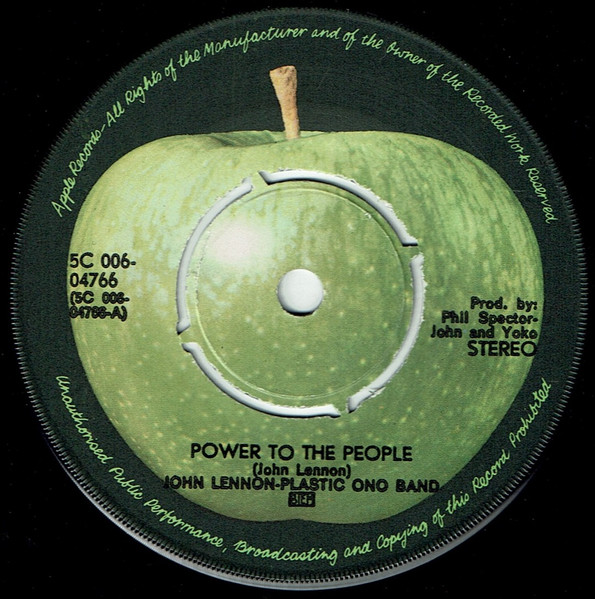
individual freedom, Lennon  calling for 'Power to the people'
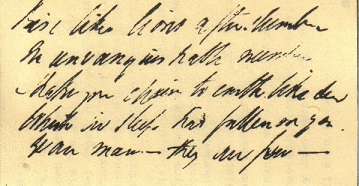
and Shelley issuing his ringing call: 'Rise like lions after slumber'.


 Power to the People3Riselikelionsmss 2


Both supported women's rights as a matter  of principle, with virtually identical
thoughts on her status: for Lennon 'Women are the slaves of the slaves'
while Shelley had asked 'Can Man be  free if Woman be a slave ?'


They both abandoned their first wives for a partner who fulfilled the
Shelleyan definition of true love - a love that went beyond sex and was
a  'thirst for communion not merely of the senses but of our whole nature,
intellectual, imaginative and sensitive'. (The comparison, incidentally, 
reveals that the passing of divorce laws in the intervening period enabled the deserted
twentieth century Cynthia to do what the nineteenth century  Harriet could not: 
begin her life anew).


Both had utopian aspects to their work and realised the value of
putting forward a vision  - Lennon in Imagine and Shelley in the final
Act of  Prometheus Unbound, Hellas and other works. This relates to something
we can see fairly clearly about Shelley but only dimly about Lennon: their 
role as 'unacknowledged legislators', Shelley's formulation that poets were ultimately
more influential than 'reasoners'. They anticipated  movements in consciousness
and in society and established them in people's minds. But they did this in a curious way -
not by overt preaching  but by bringing pleasure through their work, which,
however, went on to have a social and moral impact. 'Poetry strengthens
the moral nature  of man like exercise strengthens a limb'.


This poetic model, put forward in Shelley's 'Defence of Poetry',
(compare to Keith Richards'  comment that the fall of communism in Eastern Europe 
might have had more to do with rock n roll than most people realise) helps to explain
the relationship between Lennon's place in the business of  'entertainment' and what
may come to be seen as the high seriousness of his role as 'unacknowledged
legislator'. For an artist like this there is a tension between instruction and pleasure.
Lennon's song Imagine can be seen as working because art and  politics
were perfectly combined: his album 'Some Time in New York City' on the other hand
  failing because the politics overwhelmed the artistry.   It was a tightrope Shelley
walked as well, though he would claim, when faced with the complaint
that he had too great a 'passion for reforming  the world',
that 'didactic poetry is my abhorrence'.


'Poets are the antenna of the race' John Keats wrote, and Shelley
can be seen as a poet who picked up on the social changes of his era - such 
as the increasing energy available to humanity at the dawn of the industrial revolution
and the increased demand for democratic rights in the  emerging urban society.
  Similarly Lennon picked up on the changes in twentieth century society - the world
as a 'global village' as seen in  NASA's photographs and the accompanying feeling
that humanity could and should evolve away from warfare - and used them in his art.


Those are the large brush  similarities to which attention can be drawn
but there are others - smaller, quirkier, but perhaps no less revealing.   They both
picked up influences from outside, or rather, we find tiny mundane things of life
sparking off some train of creativity.  One example  of this in Shelley's work is the
manner in which his poem 'Swellfoot the Tyrant' (a porcine satire on the marital
difficulties of the British  royal family) was suggested:  reading one of his poems
aloud to some friends on the balcony of a house in the village of San Giuliano di Pisa 
(which overlooked the village market square) he had been interrupted
by the increasingly riotous noise of pigs in the square.


A corresponding example from Lennon's work was the way his song
'I am the Walrus' came about - the melody of the first line being based on the sound
of an ambulance siren heard in the distance.   And it is, incidentally, astonishing to
find the idea expressed in the first line of the song  ("I am he as you are he as
you are me and we are all together") almost exactly echoed in a line from
Shelley's prose:  "The words I and you and they are grammatical devices
invented simply for arrangement, and totally devoid of the intense
and exclusive sense usually attached to them".


Another significant intellectual equivalent is 'All you need is Love' (Lennon)/
'Love is .... the sole law which should govern the moral world'  (Shelley). 
But there is something else to be found in their works that is even more significant.
Both of them referred their audiences back to  one of their key lyrics, lyrics that
had expressed something central about themselves as artists. 


It may seem odd to compare Lennon's 'Strawberry  Fields Forever' with 
Shelley's 'Ode to the West Wind' but they have a common  root: 
both were written at times of personal crisis or uncertainty. 
Shelley, in the autumn of 1819, faced ferocious attack from reviewers,
a domestic crisis due to the loss of his children and, in the Peterloo Massacre, 
the apparent death of his democratic political ideals. Lennon, with the Beatles'
touring days just ended, was going through a kind of crisis of  identity
-- where was he to go from here ?


The lyrics confronted these situations and as an expression of their
importance were later overtly pointed out: 'I told you about Strawberry Fields' 
said Lennon on the White Album; 'The breath whose might I have
invoked in song' wrote Shelley in Adonais.  They both looked back to childhood,
Shelley remembering how he could seemingly outrun the wind -
'when to outstrip thy skyey speed/Scarce seemed a vision'
and Lennon recalling youthful  days in the garden of the Strawberry Fields
home in Liverpool. 'When I was a boy, everything was right' was how
he had expressed it elsewhere.


Both lyrics restored a kind of confidence and cleared the way for future creative work:
Lennon going on to work on Sergeant Pepper and Shelley  completing
Prometheus Unbound. They were examples of artistic renewal;  hence Shelley's
scribbled  quote from Euripides in his notebook under  the finished poem:
'By virtuous power, I, a mortal, vanquish thee a mighty god !'


There are those today who look for political motives behind both Shelley's
and Lennon's early deaths: the Italian authorities contriving to ram  his boat
(it was found with its bow stove in) or the CIA somehow
managing to eliminate Lennon. There is not a shred of evidence to support
these  theories, yet their deaths do have certain more subtle things in common.


On the back cover of Double Fantasy John and Yoko are pictured
on the pavement outside their Dakota home, very deliberately looking out towards 
Central Park. The symbolism is clear:  they are looking out to the world,
ending the isolation of the previous years. Similarly, at the time of  Shelley's death,
he was in the process of engagement with the world, setting up a journal as a literary
and political mouthpiece.  It was on a  journey connected
with it that he was drowned, like Lennon having his life cut short,
his work left unfulfilled.


It is in Adonais, Shelley's elegy for Keats, that one can find a poetic reading
of John Lennon's puzzling, almost accidental death. The  physical facts of his death
in the dark doorway of the Dakota seem to find expression there: 
'when he lay pierced by the shaft which flies  in darkness'.  Then, 'he went, unterrified,
into the gulf of death; ('Death is getting out of one car into another' - Lennon)
but his clear  Sprite (spirit) still reigns o'er earth' - not an exaggeration when his phrase
'Give Peace a chance' now regularly appears on politician's  lips.


The murderer (Shelley had been told that Keats had been hastened to his
death-bed by cruel reviews) is 'the noteless blot on a remembered  name',
but as for the poet - 'from the contagion of the world's slow stain
he is now secure' being 'part of the loveliness he once made more  lovely'. 
That final touch might seem over-sentimental to a modern reader, but there is nothing
sentimental in the final ominous image of Adonais,  with which Shelley provides
an image of the poet, not dallying among flowers, or as Keats put it, being some
'pet lamb in a sentimental farce',  but as someone driven out to sea
by the very wind (of inspiration) that, in the Ode to the West Wind,
he had welcomed unreservedly.


 'The breath whose might I have invoked in song              
  Descends on me; my spirit's bark is driven
  Far from the shore, far from the trembling throng
  Whose sails were never to the tempest given ....
  I am borne darkly, fearfully, afar .....'


What Lennon's death confronted the post-war generation with was exactly this
(previously unsuspected) perspective - the perils of the poetic life. 
The poem concludes with a deliberately pointed compliment to Keats:


  ...While burning through the inmost veil of heaven
     The soul of Adonais, burning like a star
     Beacons from the abode where the eternal are'.


Shelley, in opposition to the critics of the age who had sneered at Keats
and his work,  was placing him in his pantheon of the great and illustrious  dead.
The question is then, will a similar process occur in the case of John Lennon ?
Will he come to be seen - as the parallels between them suggest - 
as a poet in the Shelleyan mould, not just a simple rock n' roller but
an 'unacknowledged legislator' who 'touched the world with living flame' ?  
Though no one can be sure of the judgement of posterity,
it is certainly a strong possibility.
 
 
 'He was a morning star amongst the living
  Now that his spirit is fled   
  He shines in the heavens like the evening star
  He gives new splendour to the dead'.


 Shelleyfrontpiccrop

Write a comment

'Courageous Heart:

seven Byronic songs'

    Byron-cover6-1501 sm

1. Lord B in Motion 2. Half a Scot by Birth 3. Marathon

4.Setting Sail from Genoa 5. (Lord Byron's) Freedom song  

6.Epitaph 7.So we'll go no more a roving

Click on cover to download,

Stream from here

Find lyrics and commentaries here


SEVEN BYRONIC SONGS and LORD BYRON AND THE GREEK WAR

Byron-cover6-1501 smByroncover

LORD B. IN MOTION (Lyrics by John Webster)


 Through the valley of the Arno

In the late October sun;

Lord Byron was a-travelling

While ahead his fame did run …

‘Lock up your daughters

Or keep them chaperoned;

He’s mad, he’s bad

He’s dangerous to know’

‘Don’t even look at him darling’

The mothers would say;

But their daughters sneaked a glimpse

Through the window anyway

At the head of five coachloads

Nine horses followed on the road

With an Egyptian falcon and a monkey;

There were five fine cackling geese

He hadn’t had the heart to eat

And a bulldog and a mastiff

His accountant was coiled like a snake

On his money chest;

His four poster bed was adorned

With his family crest

Which read from Norman times ‘Trust Byron’

(Not all his ladies would agree).

Byron: ‘I have simplified my politics into an utter detestation of all governments’

‘Gin and water is the source of all my inspiration’

‘God will not always be a Tory’

He thought that the poet laureate

Was a turncoat and a fool;

He satirised him in his verse

And challenged him to a duel.

‘Lock up your daughters

Or keep them chaperoned;

He’s mad, he’s bad

He’s dangerous to know’

When Byron’s poem Childe Harold was published in March 1812 it triggered a response that can be compared to Beatlemania. ‘I awoke and found myself famous’ Byron recorded, also remembering many years later that ‘the number of anonymous love letters and portraits I received, and all from English ladies, would have been enough to fill a large volume’.

Byron rode the wave of his fame in Britain (also developing an international reputation) until 1816, when London high society turned against him, scandalised by the implosion of his marriage and  suspicions that he had conducted an incestuous affair with his half sister Augusta.

After his exile public interest in him remained strong, and ‘Lord B. in motion’ tries to convey the extent of his celebrity.  The ‘don’t even look at him’ line were addressed by an English  mother to her daughter in Florence as Byron was passing through on his way to Pisa and gives an idea of how he was regarded by polite society.

The final verse refers to his ongoing literary warfare with Robert Southey the poet laureate (part of the no-holds-barred literary battle of the time). Southey, who had supported liberal causes in his youth, had dubbed Shelley and Byron’s impending collaboration on a journal in Pisa ‘The Satanic School’, and had called for legal action against them.

HALF A SCOT BY BIRTH

Adapted from Don Juan, Canto X, Stanzas 18 and 19


I am half a Scot by birth

And bred a whole one …

‘Auld Lang Syne’ brings Scotland, one and all

Scotch plaids, Scotch snoods, the blue hills and clear streams

The Dee, the Don, Balgounie brig’s black wall,

All my boy feelings, all my gentler dreams

Floating past me …

You may remember, in a youthful fit

I railed at Scots – to show my wrath and wit

And yet, I ‘scotched, not killed’ the Scotsman in my blood -

I love the land of ‘mountain and of flood’.

I am half a Scot by birth …

And bred a whole one …

Auld Lang Syne brings Scotland, one and all

Scotch plaids, Scotch snoods, the blue hills and clear streams

The Dee, the Don, Balgounie brig’s black wall,

All my boy feelings, all my gentler dreams

Floating past me …

This childishness of mine

Comes back with ‘Auld Lang Syne’ …

After Shelley’s death in the summer of 1822 Byron took up his poem Don Juan again, and in these lines, written in his study in Pisa at the Palazzo Lanfranchi, overlooking the river Arno, he thinks back to his childhood in Aberdeen.

To visit the Dee valley (and the Linn of Dee near Braemar he visited as a child) is to understand something about Byron, the grandeur, beauty and wildness of the scenery he encountered in boyhood seeming to have permeated his spirit in some way. (Songwriter's note: Apologies, Balgounie is mis-pronounced in the song, should be Balgownie rather than 'Balgoonie' )

The lines about his ‘youthful fit’ refer to his poem ‘English Bards and Scotch Reviewers’, a savage attack on both the Scottish and English literary worlds. The Edinburgh Review, the liberal journal which he would have expected to be supportive, had trashed his first published poem ‘Hours of Idleness’. His first reaction had been complete despair but then, as he recalled later, ‘I drank three bottles of wine and sat down to make a reply’.

So ‘Half a Scot by birth’ amounts to public act of reconciliation and a farewell to the Scotland he would never see again.


MARATHON

Sources: Don Juan Canto III, Stanza 86 Childe Harold Canto III, Stanza 98 Entry in notebook 19th June 1823


 The mountains look on Marathon

And Marathon looks on the sea;

And musing there an hour alone

I dreamed that Greece might still be free

Yet freedom ! yet thy banner torn but flying

Streams like the thunderstorm against the wind;

Yet freedom ! yet thy banner torn but flying

Streams like the thunderstorm against the wind.

The dead have been awakened – shall I sleep ?

The world’s at war with tyrants – shall I crouch ?

The harvest’s ripe - and shall I pause to reap ?

I slumber not – the thorn is in my couch ....

Each day a trumpet soundeth

Its echo in my heart ....

The mountains look on Marathon

And Marathon looks on the sea;

And musing there an hour alone

I dreamed that Greece might still be free

‘I would do anything for the land which gave Europe its science and its art’ said Byron in Pisa, as well as telling Shelley’s cousin Tom Medwin ‘I mean to return to Greece, and shall in all probability die there’.

 In Genoa, where he moved after leaving Pisa in the autumn of 1822, he assisted two German volunteers returning from Greece, and this rekindled his interest in supporting the insurrection of Greek nationalists, who had risen to try to end fopur centuries of rule by the Ottoman empire. When two emissaries from the London Greek Committee visited him and asked for help his mind was made up. The lines from his notebook ‘The dead have been awakened ...’ were written a month before departure, and convey his mental preparation for what lay ahead.

SETTING SAIL FROM GENOA (Lyrics by John Webster)


Setting sail from Genoa

With a chest of gold and medicines,

To join the Grecian fight for liberty;

Sailing slowly southwards

Past the volcanic islands

And out beyond the heel of Italy.

It was as if ten long years

Were lifted from his shoulders,

He felt like he was young again;

And Byron then remembered

The Springtime of his manhood

And the women who had loved him then ....

After twenty days on board

They saw the mountains of Morea,

Rising wreathed in cloud above the sea;

And Byron came on deck then

To catch sight of the country

Where he thought he could well meet his destiny ....

Everyone was watching

On the isle of Cephalonia

When Byron's boat moored at Argostoli,

Through telescopes and glasses

They viewed the noble poet

Whose life had now become legendary.

And so Byron left Genoa in July 1823, planning to sail to Cephalonia, then under a British mandate, to wait for firm information on the situation in Greece.  He had chartered The Hercules, ‘a tub built on the lines of a baby’s cradle’ according to Trelawny, and captained by Captain Scott, a Cockney who ‘abused Byron most obstreperously for throwing himself away on these villains’ - the Suliotes who swarmed onto the ship when Byron arrived in Cephalonia – ‘when there were so many honest men suffering at home’. Byron and Trelawny teased the Captain during the journey by getting into his prize scarlet waistcoat, taking one arm each (he was so large they both fitted) and jumping into the sea with it.

When they arrived on Cephalonia Trelawny, impatient with what he saw as Byron’s vacillation, went on ahead to the mainland, where – completely misreading the situation - he immediately joined up with the treacherous warlord Odysseus and was nearly assassinated for his pains. Byron however, waited for hard news from the mainland – demonstrating the blend of scepticism and idealism that underlay his expedition.

(LORD BYRON’S) FREEDOM SONG

(Adapted from lyrics in a letter dated November 5th 1820; music Dave Eastoe)

When there is no freedom to fight for at home

Let one combat for that of ones neighbours;

And think of the glory of Greece and of Rome ….

And get knocked on the head for ones labours !

Finally in January 1824 Byron arrived in the coastal town of Missolonghi to throw his weight behind one part of the Greek forces, the ‘Provisional government of western Greece’. There he began to try to unite the different factions in the town and the country, to shore up Missolonghi’s defences and raise a loan from banks in London for the Greek cause. (Download Missolonghi narrative here). But on 24th April he succumbed to cerebral malaria.

‘The news of his death came upon London like an earthquake’ a journalist wrote. ‘No one could remember the death of a poet having such an effect’. Another comment was:‘I felt as if I had lost a friend – he was the noblest spirit in Europe’.

The piece of Byronic wit in (Lord Byron’s) Freedom Song was written in Ravenna when he was providing assistance to Italian nationalists who wanted to rid Italy of rule by Austro-Hungarian Empire. It demonstrates how he would build up a noble or heroic theme only to undercut or subvert it. He did this to the great lines ‘The mountains look on Marathon...’ from Don Juan and also when he wrote his tribute to the Ukranian patriot Mazeppa. Both admirers, critics, and those who met him routinely complained that he would never stick to a point of view, but when it came to the point in Greece, he would stand by the cause to the bitter end.

EPITAPH

Adapted from Childe Harold Canto IV Stanza 137

But I have lived, and have not lived in vain

My mind may lose its force, my blood its fire;

But there is that within me which shall tire

Torture and time, and breathe when I expire

Like the remembered tone of a mute lyre.

In 1818 Byron had published the last Canto of Childe Harold’s Pilgimage, in which he included a reflection on what his legacy could amount to.  In an age when belief in an afterlife is on the wane these lyrics point to an immortality of the spirit which certainly a great poet like Byron can aspire to. What survives of the rest of us is perhaps less measurable, but at best is seen perhaps in a diffused but none the less real contribution to humanity, liberty, and society, that goes on to build up the human story – for all we know, the only self-aware form of life in the universe.

7. So We’ll Go No More a Roving

(Written in Venice 1819)

So, we'll go no more a roving,

So late into the night;

Though the heart be still as loving

And the moon be still as bright.

For the sword outwears its sheath

And the soul outwears the breast;

And the heart must pause to breathe

And love itself have rest

Though the night was made for loving

And the day returns too soon

Yet we’ll go no more a roving

By the light of the moon.

Though the night was made for loving

And the day returns too soon

Yet we’ll go no more a roving

By the light of the moon.

One of Byron’s most famous lyrics, whose jumping off point was a contemporary Scottish folk song, is pressed into service (see narrative ? of LB & GW) as a farewell song for the younger Romantics: Keats, Shelley and now Byron who had all died young.

They had all died freethinkers, unreconciled to orthodox formulations of God; in a sense today’s society, which also finds simple all-explanatory formulas problematic, has only just caught up with them.

Romantic poetry has been called ‘a fusion of love, philosophy, exact observation and spiritual vision’ (Grevel Lindrop) which doesn’t seek to express a coherent system of thought but reflects a ‘painfully fragmented existence’ (Richard Cronin). Which is a good cue for a last quotation from Byron: ‘When a man talks of system’, he once wrote, ‘his case is hopeless”.

John Webster: vocals; Dave Eastoe: Guitars, keyboards, bouzouki; Ruth Murray: Vocals, flute; Steve Homes: flamenco guitar; Keith Parker: Guest vocals

DIALOGUES:


Dialogue 1: In Genoa Byron converses with the visiting Lady Blessington on love, fame and his imminent departure to Greece. Listen to the dialogue on YouTube here.

Ruth Murray: Voice of Lady Blessington; John Webster: Voice of Lord Byron

Lady Blessington has been described as ‘shrewd and sympathetic’ and her book ‘Conversations with Lord Byron’, from which these dialogues are largely reconstructed, is generally held to be both fair and accurate. Born in humble circumstances in Ireland and sold by her father to a farmer, she had been rescued by an English officer and then had married Lord Blessington. She came to preside over a literary salon in St James’s Square, London, so had witnessed Byron’s years of fame and ultimate fall from grace in London society. A year younger than Byron, she was ‘entrancingly beautiful’ and was dubbed ‘most gorgeous’ after a portrait of her caused a sensation amongst her peers.

Dialogue 2: Byron considers the issue of religion in Cephalonia

 Andrew Stubbings: Voice of Dr James Kennedy

Dr James Kennedy, an Edinburgh doctor with ‘gentle manners and a kind heart’, was the physician to the British garrison on Cephalonia. A Methodist, he sought to defend literalist Christianity against Enlightenment ideas – his meetings on Cephalonia, some of which Byron attended, were for this purpose. (Byron quipped that the respectable attendance at these meetings owed something to the beauty of his young wife). He died in Jamaica in 1827 fighting an outbreak of yellow fever, and his widow subsequently oversaw the publication of his book ‘Conversations on the Subject of Religion with Lord Byron’, from which these dialogues, again, are largely reconstructed.

Further reading:

BYRON The Flawed Angel, by Phyllis Grosskurth. Perceptive modern biography.

The Last Attachment, by Iris Origo. The classic description of Byron and Teresa’s relationship.

The Last Journey, by Harold Nicolson. An in-depth account of his journey to Greece.

That Greece Might Still be Free, by William St. Clair. An account of the involvement of Philhellenes, including Byron, in the Greek War of Independence. Lord Byron: Detached Thoughts

Don Juan, The Curse of Minerva

Edward Trelawny: Records of Shelley, Byron and the Author